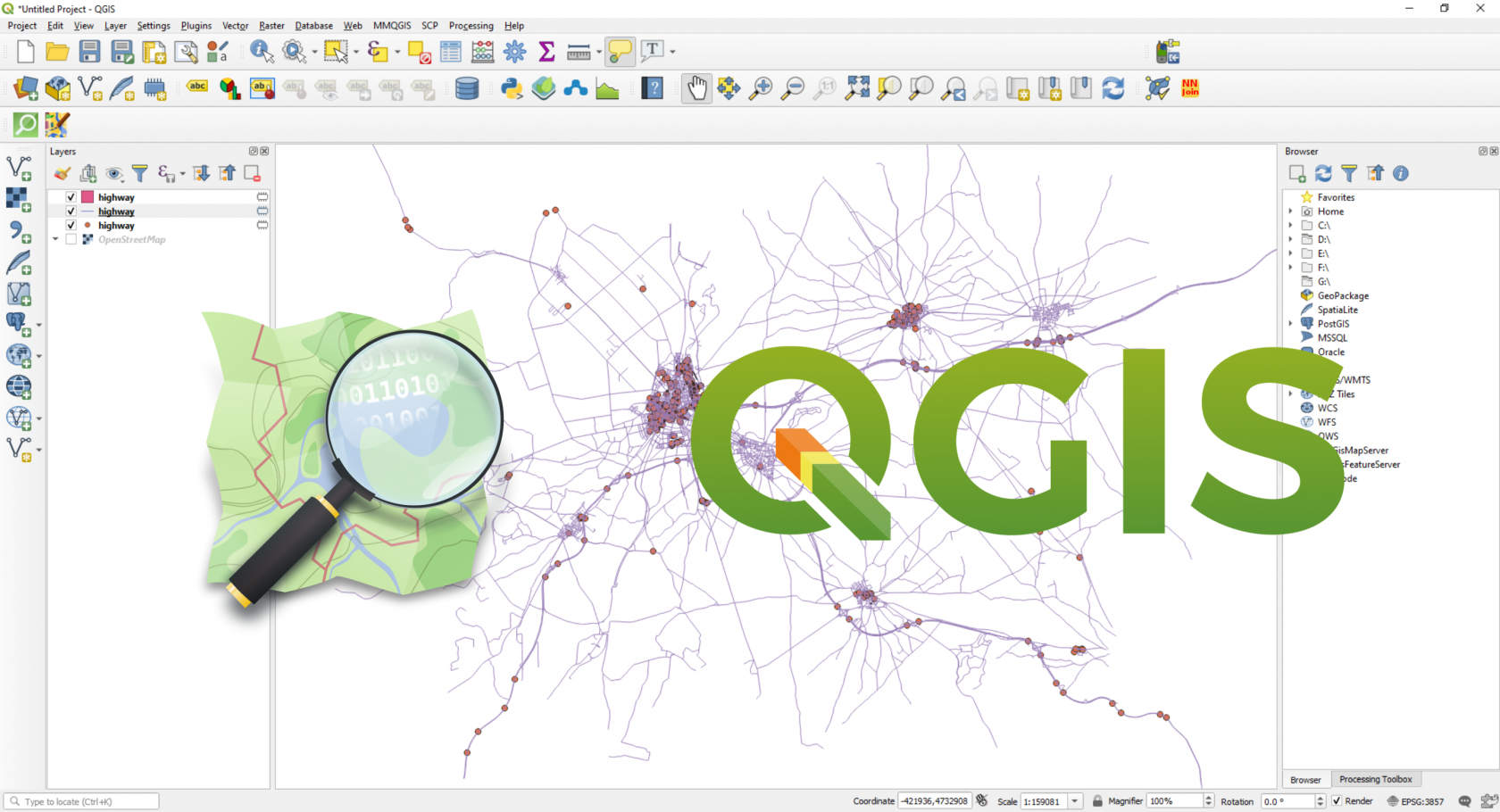
# QGIS

![qgis.png](https://books.asgmgh.com/uploads/images/gallery/2023-03/scaled-1680-/qgis.png)

**<u><span style="font-size: 16.0pt; line-height: 107%; font-family: 'Times New Roman',serif;">QGIS</span></u>**

<span style="font-size: 12.0pt; line-height: 107%; font-family: 'Times New Roman',serif;">QGIS (Quantum GIS) is a free and open-source Geographic Information System (GIS) software that allows users to visualize, analyze, and manage geospatial data. It is a cross-platform software that can run on Windows, macOS, Linux, and other operating systems.</span>

<span style="font-size: 12.0pt; line-height: 107%; font-family: 'Times New Roman',serif;">QGIS provides a wide range of tools for handling and processing various types of geospatial data, such as vector, raster, and spatial databases. Users can use QGIS to perform spatial analysis, create maps, edit and manage geospatial data, and share their work with others.</span>

<span style="font-size: 12.0pt; line-height: 107%; font-family: 'Times New Roman',serif;">Some common applications of QGIS include:</span>

- <span style="font-size: 12.0pt; line-height: 107%; font-family: 'Times New Roman',serif;">Creating and editing maps: QGIS allows users to create custom maps using various types of data, such as satellite imagery, topographic maps, and demographic data.</span>
- <span style="font-size: 12.0pt; line-height: 107%; font-family: 'Times New Roman',serif;">Spatial analysis: QGIS offers a range of tools for spatial analysis, including buffer analysis, spatial joins, and interpolation.</span>
- <span style="font-size: 12.0pt; line-height: 107%; font-family: 'Times New Roman',serif;">Data management: QGIS allows users to manage and manipulate geospatial data from various sources, such as shapefiles, geodatabases, and CSV files.</span>
- <span style="font-size: 12.0pt; line-height: 107%; font-family: 'Times New Roman',serif;">Geocoding: QGIS can be used for geocoding, which involves converting addresses or place names into geographic coordinates.</span>

<span style="font-size: 12.0pt; line-height: 107%; font-family: 'Times New Roman',serif;">How QGIS is used in the control room:</span>

<span style="font-size: 12.0pt; line-height: 107%; font-family: Symbol; mso-fareast-font-family: Symbol; mso-bidi-font-family: Symbol;"><span style="mso-list: Ignore;">·<span style="font: 7.0pt 'Times New Roman';"> </span></span></span><span style="font-size: 12.0pt; line-height: 107%; font-family: 'Times New Roman',serif;">Acquisition of coordinates to create a geo-fence and / or buffer zone.</span>

<span style="font-size: 12.0pt; line-height: 107%; font-family: Symbol; mso-fareast-font-family: Symbol; mso-bidi-font-family: Symbol;"><span style="mso-list: Ignore;">·<span style="font: 7.0pt 'Times New Roman';"> </span></span></span><span style="font-size: 12.0pt; line-height: 107%; font-family: 'Times New Roman',serif;">QGIS can be used in conjunction with TX 140 software to monitor the location of earth moving vehicles and also visualize weather patterns.</span>